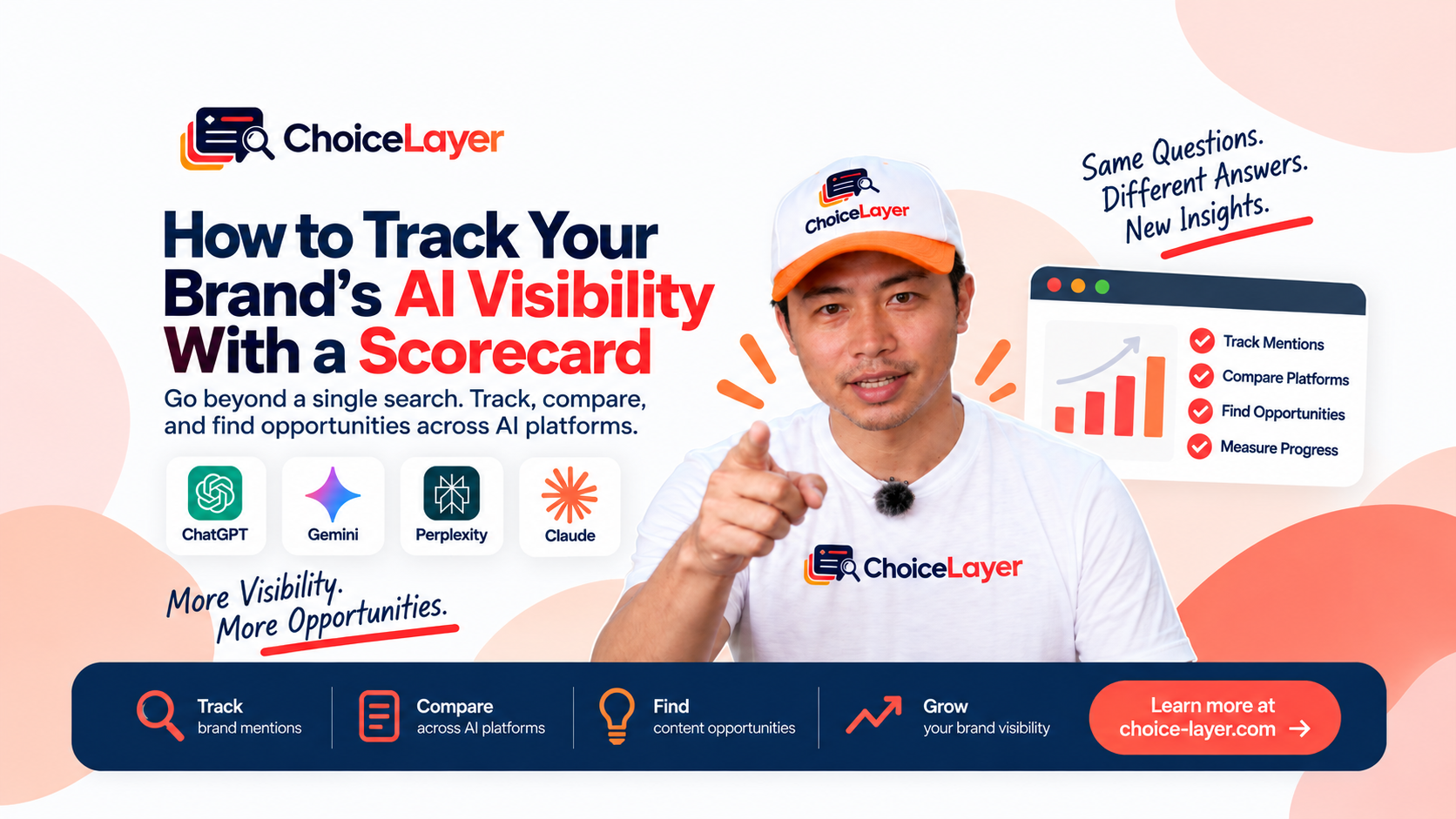
Is ChatGPT recommending your business? What about Gemini, Perplexity, or Claude?
As more people use AI platforms to discover brands, compare solutions, and research potential vendors, businesses need a better way to understand whether they’re appearing in AI-generated responses.
But there’s a problem: Checking your brand once in ChatGPT doesn’t tell you much about your overall AI search visibility.
AI-generated answers can vary depending on the question, platform, model, and timing.
That’s why a structured AI Visibility Scorecard can be useful.
Instead of relying on isolated searches, you can systematically track brand mentions, citations, competitor visibility, and recommendation patterns over time.
In this guide, we’ll explain how to build and use a simple AI visibility scorecard to support your SEO, Answer Engine Optimization (AEO), and Generative Engine Optimization (GEO) strategy.
What Is AI Brand Visibility?
AI brand visibility refers to how frequently and in what context your business appears in AI-generated responses to relevant user questions.

Unlike traditional SEO, where businesses often track rankings for specific keywords, AI visibility can involve several different indicators:
- Brand mentions: Does the AI platform mention your business?
- Recommendations: Does it actively suggest your business as an option?
- Citations: Does the response link to or reference your website?
- Competitor visibility: Which competing brands appear in the same response?
- Context and sentiment: How is your business described?
- Prompt coverage: Which types of questions trigger your brand’s appearance?
These measurements provide different perspectives on how AI platforms represent your business.
For example, an AI tool might mention your brand without linking to your website. Another might cite your content without recommending your company.
Both are useful observations, but they represent different forms of visibility.
Why Checking ChatGPT Once Isn’t Enough
Imagine you’re running a B2B marketing agency.
You ask ChatGPT:
“What are the best B2B lead generation agencies?”
Your agency appears in the response.
That’s encouraging, but what happens when you ask a slightly different question?
“Which companies provide outsourced B2B lead generation services in Taiwan?”
Your agency might not appear at all.
Now imagine testing the same questions in Gemini, Perplexity, and Claude. You could receive different recommendations and citations.
A single AI response is a snapshot, not a reliable visibility benchmark.
Rather than drawing conclusions from one result, businesses should test consistent prompt sets across multiple platforms and repeat the process over time.
This approach helps distinguish isolated appearances from recurring patterns.
How to Build an AI Visibility Scorecard
You don’t necessarily need an expensive AI monitoring platform to start measuring visibility.
A spreadsheet in Google Sheets or Microsoft Excel can provide a useful foundation.
Here are the steps.
Step 1: Choose Relevant AI Search Prompts
Start by identifying the questions potential customers might ask when researching your industry, services, or products.
Focus on questions with genuine buyer intent rather than only branded searches.
For a B2B lead generation agency, examples might include:
- What are the best B2B lead generation agencies?
- Which companies offer outsourced sales development services?
- How can I find qualified B2B leads in Taiwan?
- Which agencies specialize in international B2B lead generation?
- What are the alternatives to hiring an in-house SDR team?
These prompts represent different stages and types of buyer research.
Tip: Start with five to ten prompts. A smaller, relevant set tested consistently is more useful than a large set you cannot maintain.
You can expand your tracking as you identify additional customer questions.
Step 2: Test the Same Prompts Across AI Platforms
Next, test your selected prompts across relevant AI platforms.
These might include:
- ChatGPT
- Google Gemini
- Perplexity
- Claude

Use the same wording wherever possible to make your observations easier to compare.
Record the platform, test date, and model or search mode when available.
Different AI systems may generate different responses because they use different models, retrieval systems, and source-selection approaches.
Keep in mind that identical prompts do not guarantee identical answers, even within the same platform.
The objective is to identify patterns across repeated observations rather than treating each response as definitive.
Step 3: Record Your AI Visibility Metrics

Create a spreadsheet with the following columns:
| Metric | What to Record |
|---|---|
| Date | When the prompt was tested |
| Prompt | The exact question submitted |
| Buyer Intent | The purpose behind the question |
| AI Platform | ChatGPT, Gemini, Perplexity, etc. |
| Brand Mention | Yes or No |
| Recommendation | Whether the brand was actively suggested |
| Website Citation | Whether your website was cited or linked |
| Competitor Mentions | Other relevant brands appearing |
| Position | Where the brand appeared, when applicable |
| Sentiment / Context | Positive, neutral, negative, or mixed |
This structure helps you distinguish between brand awareness, recommendation visibility, and website citations.
You can also include the response URL or a saved copy of the output to support future reviews.
Important: A brand mention isn’t necessarily an endorsement.
An AI response may mention a company as a comparison, alternative, or example without actually recommending it.
That distinction matters when evaluating performance.
Step 4: Compare Your Visibility Against Competitors
AI visibility becomes more informative when viewed in a competitive context.
For example, suppose you’re tracking ten buyer-focused prompts across four AI platforms.
Your brand appears in 12 of the 40 responses, while a competitor appears in 25.
That observation could suggest the competitor has broader visibility within your tested prompt set.
However, it doesn’t necessarily mean the competitor is more visible across all AI search activity.
Your results only represent the prompts, platforms, and testing conditions included in your analysis.
To make competitive tracking more useful, examine:
- Which prompts consistently mention competitors but not your brand
- Whether competitors receive more website citations
- What third-party sources AI platforms reference
- How competitor positioning differs from yours
- Which topics appear to generate more brand recommendations
These observations can help identify content and authority-building opportunities.
Step 5: Calculate Your AI Visibility Metrics
Once you’ve collected your responses, you can calculate simple performance indicators.
Brand Mention Rate
Brand Mention Rate = (Responses Mentioning Your Brand ÷ Total Responses Tested) × 100
For example:
If your brand appears in 12 out of 40 tested responses, your brand mention rate is 30%.
Recommendation Rate
Recommendation Rate = (Responses Recommending Your Brand ÷ Total Responses Tested) × 100
This measures how often your business is actively recommended rather than simply mentioned.
Website Citation Rate
Website Citation Rate = (Responses Citing Your Website ÷ Total Responses Tested) × 100
This shows how often tested responses link to or reference your website.
These metrics are useful for internal benchmarking, but they should not be interpreted as market-wide AI visibility or audience reach.
The quality and relevance of the prompts matter just as much as the numerical results.
Step 6: Track Changes Over Time
One of the biggest benefits of maintaining an AI visibility scorecard is the ability to compare results across different periods.
For example, you could measure:
| Metric | Month 1 | Month 2 | Month 3 |
|---|---|---|---|
| Brand Mention Rate | 20% | 28% | 35% |
| Recommendation Rate | 10% | 15% | 22% |
| Website Citation Rate | 8% | 12% | 18% |
Illustrative figures only.

The goal is to determine whether your brand’s visibility improves, declines, or remains relatively stable within a consistent testing framework.
For more reliable comparisons, maintain the same core prompts, platforms, and testing conditions.
Document significant changes, including model updates, prompt adjustments, and newly published content.
You might conduct monthly reviews initially, then increase frequency if your industry or competitive landscape changes rapidly.
How to Turn AI Visibility Insights Into Action
Collecting AI visibility data is only the beginning.
The real value comes from translating your findings into better marketing decisions.
For example:
If competitors appear for prompts where your brand is missing:
Review whether your website addresses those customer questions clearly and comprehensively. Identify relevant content gaps and opportunities to strengthen your positioning.
If your brand is mentioned but rarely cited:
Review your website’s accessibility, content quality, supporting evidence, and relevant third-party references. These improvements may help strengthen your digital presence, although they do not guarantee AI citations.
If your brand appears only for branded prompts:
Consider creating helpful content around broader industry questions, service comparisons, and customer problems.
If your visibility changes significantly between reporting periods:
Review prompt consistency, platform changes, and content updates before attributing the movement to your marketing efforts.
A scorecard helps you prioritize investigation rather than relying on assumptions.
How AI Visibility Tracking Supports SEO, AEO, and GEO
AI visibility tracking shouldn’t operate separately from your existing search strategy.
Traditional Search Engine Optimization (SEO) focuses on helping your website become discoverable through search engines.
Answer Engine Optimization (AEO) emphasizes making information clear, accessible, and useful for answer-oriented search experiences.
Generative Engine Optimization (GEO) focuses on improving how brands and their content may be discovered, represented, and referenced in generative AI experiences.
These approaches overlap.
Strong technical foundations, relevant content, clear brand positioning, and credible supporting sources can benefit multiple discovery channels.
An AI visibility scorecard adds another measurement layer, helping your business understand how it appears in AI-generated responses alongside traditional organic search performance.
Rather than creating three disconnected strategies, businesses can use their SEO, AEO, and GEO insights together.
Common AI Visibility Tracking Mistakes to Avoid
Before building your scorecard, be aware of several common problems.
1. Testing only one AI platform
A brand’s visibility in ChatGPT does not necessarily reflect its visibility in Gemini, Perplexity, or Claude.
2. Changing prompts every time
Continuously modifying your questions makes period-over-period comparisons more difficult.
3. Treating every mention as a recommendation
Being named in a response is not the same as being suggested as a suitable solution.
4. Ignoring competitors
Tracking only your own mentions can obscure broader competitive changes.
5. Focusing entirely on one visibility percentage
A single score cannot fully capture the quality, context, or commercial relevance of AI-generated responses.
6. Assuming visibility automatically produces traffic or leads
AI mentions and citations do not guarantee website visits, inquiries, or conversions.
Where possible, evaluate AI visibility alongside referral traffic, organic search performance, and CRM outcomes.

Start Measuring Your AI Search Visibility
You don’t need a complicated dashboard to begin tracking how AI platforms represent your business.
Start with a few relevant customer prompts, test them across multiple AI platforms, and record the results in a consistent scorecard.
Then review the patterns.
Which platforms mention your brand? Which competitors are recommended? Where do citations appear? And how do these observations change over time?
The goal isn’t simply to get mentioned by AI. It’s to understand your visibility well enough to make better decisions.
At ChoiceLayer, we help businesses connect traditional SEO with AEO and GEO strategies to improve discoverability across evolving search experiences.
If you’re looking to understand how AI search fits into your broader organic growth strategy, we’d be happy to help.
Explore our SEO, AEO, and GEO services: https://choice-layer.com/
Recommended blog enhancements
For the WordPress version, I recommend including four supporting visuals and the original YouTube Short.
| Placement | Visual |
|---|---|
| Featured image | How to Track AI Brand Visibility With a Scorecard — ChoiceLayer branding |
| After “What Is AI Brand Visibility?” | Brand mentions, citations, and competitor visibility infographic |
| Under “How to Build an AI Visibility Scorecard” | Actual or illustrative scorecard screenshot |
| Under “Track Changes Over Time” | AI visibility trend chart |
YouTube Short placement: Embed the Short immediately after the introduction, before the “What Is AI Brand Visibility?” heading. Add the caption: Watch: How to Track AI Brand Visibility With a Scorecard (55 seconds).
Internal links to add: Link naturally to your existing GEO educational article, your article about testing AI recommendations across multiple platforms, and your ChoiceLayer service pages. Use descriptive anchor text rather than generic “click here” links.
Suggested CTA: “Want to know whether AI platforms recommend your brand? Explore ChoiceLayer’s SEO, AEO, and GEO consulting services.”
This article can serve as the central educational resource for your AI visibility scorecard topic, while the YouTube Short, Facebook Reel, and LinkedIn posts direct interested viewers to the more detailed explanation.
Leave a Reply