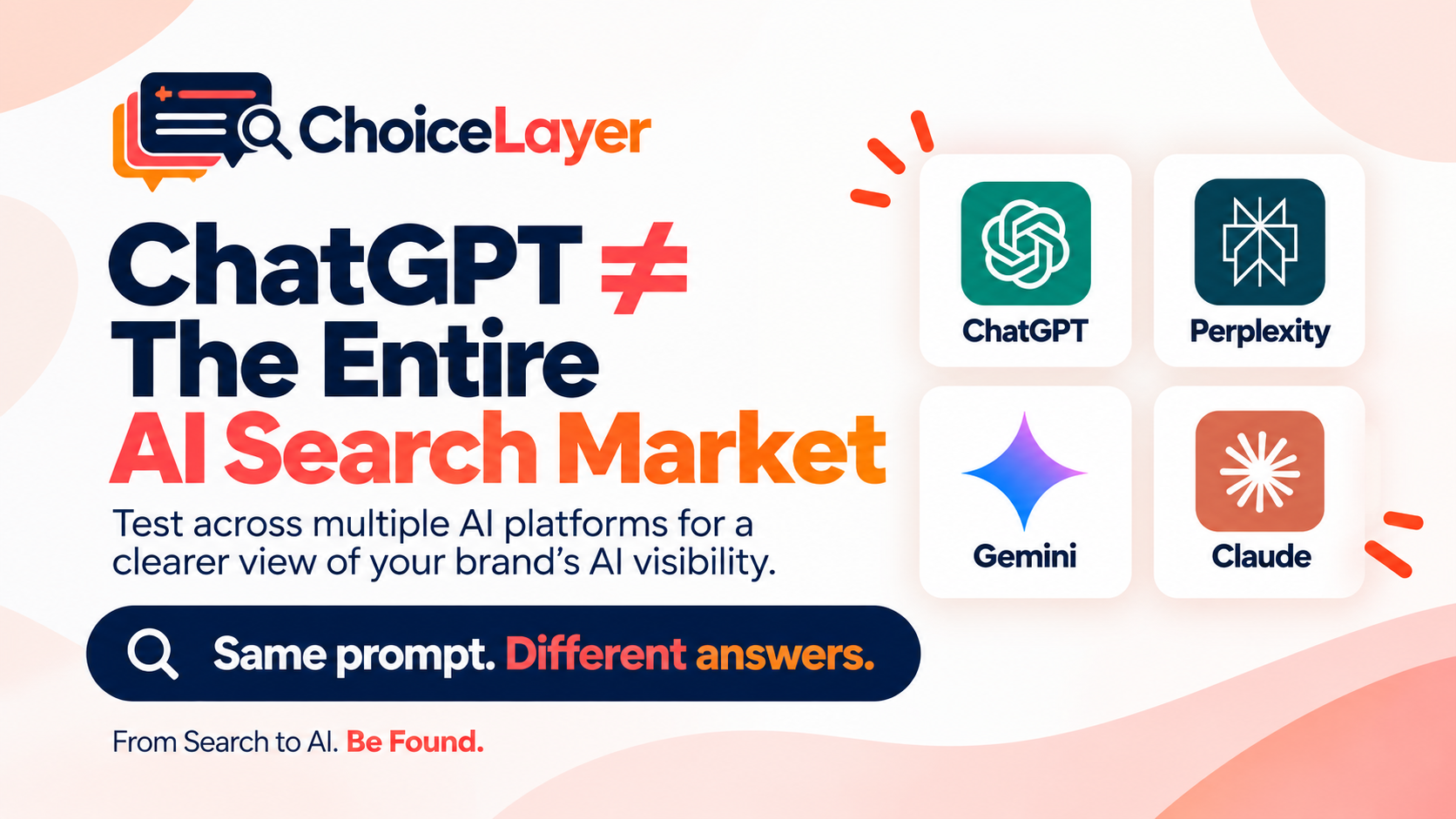
If you want to know whether your brand is visible in AI search, opening ChatGPT and asking one question is a reasonable place to start.
But it should not be where your analysis ends.
ChatGPT is only one part of a much larger AI discovery ecosystem.
A buyer could research your category using ChatGPT today, Perplexity tomorrow, Gemini through Google, or Claude while comparing vendors and evaluating options.
And those platforms do not necessarily recommend the same companies.
That means:
Your brand can be highly visible on one AI platform and almost invisible on another.
To understand your real AI visibility, you need to test across multiple platforms using the same set of commercially relevant prompts.

ChatGPT Is Not the Entire AI Search Market
ChatGPT receives much of the attention around generative AI, and understandably so.
But from a brand visibility perspective, measuring ChatGPT alone can give you an incomplete picture.
Different AI platforms may use different:
- Retrieval systems
- Search integrations
- Sources
- Citation methods
- Ranking signals
- Training data
- Browsing capabilities
- Ways of interpreting user intent
As a result, the exact same question can produce very different recommendations.
For example, imagine testing this prompt:
What are the best SEO agencies in Taiwan?
ChatGPT might recommend:
- Brand A
- Brand B
- Brand C
Perplexity might return:
- Brand C
- Brand A
- Brand F
Gemini could show:
- Brand B
- Brand D
- Brand A
And Claude might provide yet another set of companies.
There does not have to be one universal AI ranking.
Each platform can create a different discovery environment.
Use the Same Prompts Across Every AI Platform
The easiest way to compare your visibility is to keep the prompts consistent.
Instead of asking ChatGPT one question, Gemini another, and Perplexity something completely different, create a fixed test set.

For example:
- What are the best SEO agencies in Taiwan?
- Which SEO agency is best for B2B companies in Taiwan?
- Who can help a company improve its visibility in ChatGPT?
- What are the best agencies for SEO and AI search optimization?
- Which AI search consultants should a B2B company consider?
Then run those same prompts through each platform you want to evaluate.
For example:
ChatGPT → Perplexity → Gemini → Claude
This gives you a much cleaner comparison.
You are no longer asking:
“Did ChatGPT recommend us?”
You are asking:
“How consistently does our brand appear when buyers ask similar questions across the AI platforms they use?”
That is a much more meaningful measurement.
What Should You Track?
You do not need an overly complicated AI visibility dashboard to start.
For each prompt and platform, track a few basic signals.
1. Brand mention
Did the AI mention your company at all?
This is the simplest indicator of whether your brand is entering the AI-generated consideration set.
2. Citation
Did the platform cite your website or another source that discusses your brand?
A brand mention and a citation are not the same thing.
Your company might appear in an answer without your website being referenced.
3. Position
If several companies are recommended, where does your brand appear?
Being mentioned eighth is different from consistently appearing in the top three.
4. Competitors
Which competitors appear repeatedly?
This is often one of the most useful parts of AI visibility testing.
If the same competitor appears across ChatGPT, Perplexity, Gemini, and Claude, investigate why.
They may have stronger:
- Third-party mentions
- Industry authority
- Reviews
- Comparison content
- Structured information
- Media coverage
- Backlinks
- Brand recognition
5. Consistency
Do you appear across multiple prompts and platforms?
One appearance can be interesting.
Repeated appearances reveal a pattern.
Different AI Platforms May Have Different Strengths
You should avoid assuming every AI platform behaves the same way.
Their capabilities also continue to evolve, so the objective is not to permanently categorize each one.
Instead, understand that users may experience your brand differently depending on where they search.

ChatGPT
Users may use ChatGPT for conversational research, recommendations, comparisons, and deeper follow-up questions.
Perplexity
Perplexity is often used as a research-oriented AI search experience where sources and citations play an especially visible role.
Gemini
Gemini operates within Google’s broader ecosystem, making it particularly important to watch as AI becomes increasingly integrated into traditional search and discovery behavior.
Claude
Claude may be used for deeper research, analysis, comparison, and longer-form decision support.
The key point is not that one platform is better than another.
It is that:
Your customers may use more than one of them.
Your measurement strategy should reflect that.
One AI Platform Can Give You a False Sense of Visibility

Suppose your brand appears in three out of five ChatGPT prompts.
That might look encouraging.
But then you run those same prompts elsewhere:
| Platform | Brand Visibility |
|---|---|
| ChatGPT | 3/5 prompts |
| Perplexity | 1/5 prompts |
| Gemini | 0/5 prompts |
| Claude | 2/5 prompts |
Now the picture looks very different.
You are not universally visible across AI discovery.
You may simply perform well within one platform.
The opposite can happen too.
A brand that seems invisible when tested only in ChatGPT could actually appear frequently in Perplexity or Gemini.
That is why a single-platform test should be treated as a snapshot, not a complete AI visibility assessment.
Look for Patterns, Not One Lucky Recommendation
One of the biggest mistakes in AI visibility testing is celebrating—or panicking over—one answer.
AI-generated recommendations can vary.
Instead of focusing on individual outputs, look for patterns across:
- Multiple prompts
- Multiple platforms
- Multiple testing periods
For example, if your brand appears consistently for:
“Best SEO agency in Taiwan”
but rarely for:
“Best AI search consultant for B2B companies”
that tells you something useful.
Your brand may already have traditional SEO authority but lack strong associations with AI search, GEO, or a specific use case.
That creates a strategic opportunity.
You can then strengthen content and external signals around the topics where visibility is weakest.
Turn AI Visibility Testing Into a Repeatable Scorecard
A basic scorecard might look like this:
| Prompt | Platform | Mentioned? | Cited? | Position | Competitors |
|---|---|---|---|---|---|
| Best SEO agencies in Taiwan | ChatGPT | Yes | Yes | 3 | A, B, C |
| Best SEO agencies in Taiwan | Perplexity | No | No | — | A, D, F |
| Best SEO agencies in Taiwan | Gemini | Yes | No | 5 | B, C, D |
| Best SEO agencies in Taiwan | Claude | Yes | — | 2 | A, E |
Over time, you can start answering more important questions.
Is visibility improving?
Which prompts are generating mentions?
Which competitors dominate?
Which sources are repeatedly cited?
Which topics do AI systems associate with your brand?
Those insights can guide your broader SEO, AEO, and GEO strategy.
AI Visibility Is Bigger Than ChatGPT
ChatGPT is an important platform.
But ChatGPT visibility is not the same thing as AI visibility.
If your goal is to understand how AI systems represent your brand when potential customers research providers, compare options, and make decisions, you need a broader test.
Use the same commercially relevant prompts across several AI platforms.
Track mentions, citations, position, competitors, and consistency.
Then look for patterns.
Because the goal is not to win one AI answer.
It is to become a brand that consistently appears wherever your customers are using AI to make decisions.
Want to Check Your Brand’s AI Visibility?
ChoiceLayer helps businesses understand how they appear across traditional search and emerging AI discovery environments.
We evaluate how brands are:
- Mentioned
- Recommended
- Cited
- Positioned against competitors
- Associated with important customer needs
From Search to AI. Be Found.
Leave a Reply