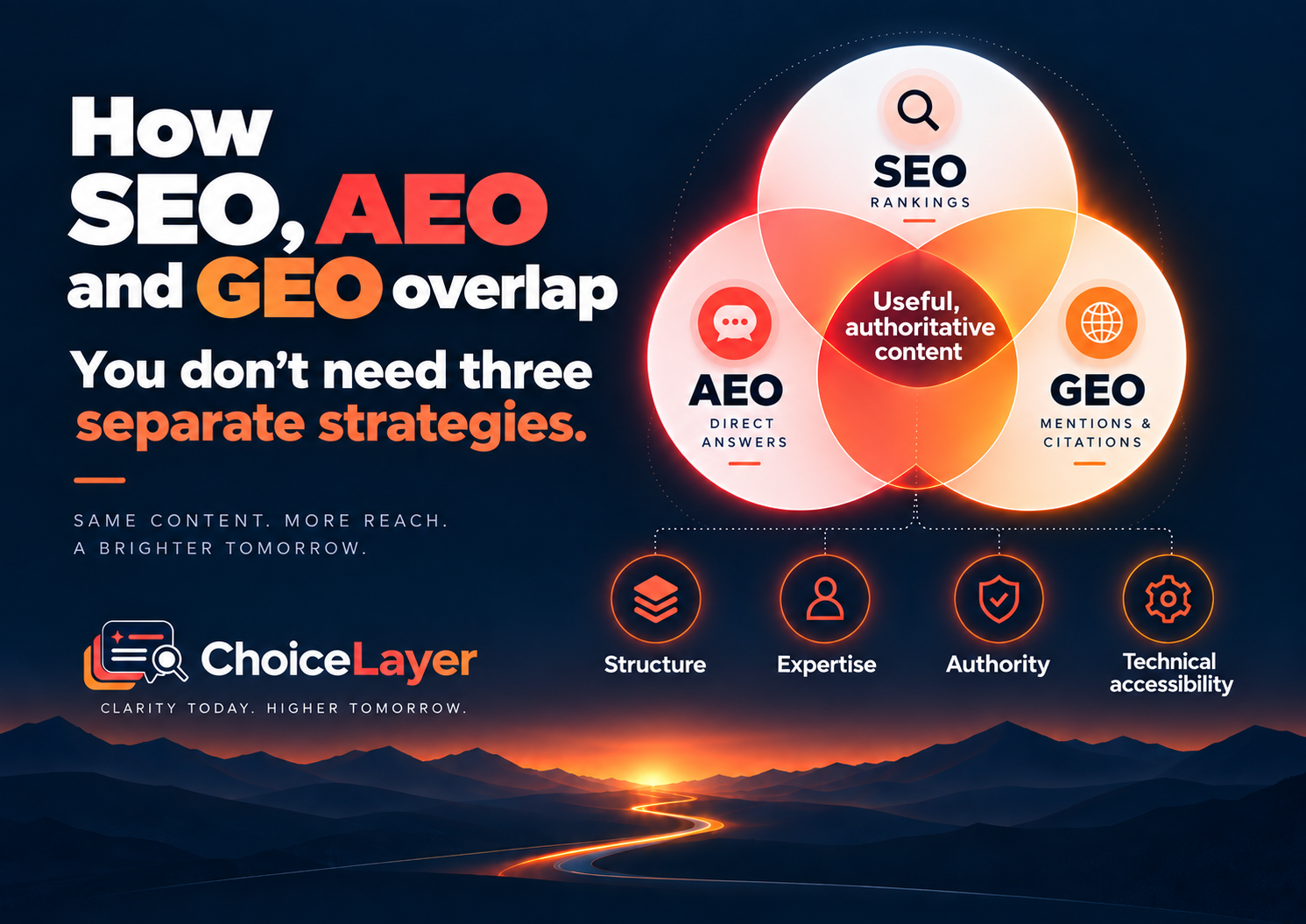
SEO, AEO and GEO are often discussed as if they are three completely separate disciplines.
That can make the shift toward AI search feel more complicated than it needs to be.
Businesses start asking whether they now need:
- One strategy for traditional SEO
- Another strategy for answer engines
- A third strategy for generative AI platforms
In reality, the three overlap far more than many teams realize.
The platforms may surface information differently, but the underlying content foundation is often the same.
The bigger opportunity is not to build three disconnected strategies.
It is to build one strong content system that can perform across search, answers and AI discovery.

What’s the Difference Between SEO, AEO and GEO?
The terms are related, but they are not identical.
SEO: Search Engine Optimization
SEO focuses on improving visibility in traditional search engines.
The goal may include:
- Ranking for relevant search queries
- Increasing organic traffic
- Improving click-through rates
- Helping users discover important pages
- Strengthening site authority
A traditional search experience typically presents users with a list of pages to choose from.
Your content needs to earn visibility and give the user a reason to click.
AEO: Answer Engine Optimization
AEO focuses on making content easier for answer engines to identify, extract and present directly.
This may include:
- Featured snippets
- Direct answers
- Voice-search responses
- Q&A experiences
- AI-assisted search results
AEO places more emphasis on concise explanations, clear formatting and content that directly answers specific questions.
GEO: Generative Engine Optimization
GEO focuses on improving how a brand, website or source appears within generative AI experiences.
Instead of simply ranking a webpage, an AI system may:
- Mention your brand
- Summarize your content
- Cite your page
- Use your information as supporting evidence
- Compare your brand with alternatives
This creates a different type of visibility.
A user may encounter your brand without ever seeing a traditional list of search results.
The Mistake: Treating Them as Three Separate Content Strategies
The terminology is different, so it is easy to assume the strategies should be completely different too.

That can create unnecessary silos.
One team produces SEO content.
Another creates answer-focused content.
Someone else starts publishing content specifically for AI search.
Before long, the business may have three different processes targeting very similar topics.
That can lead to duplicated work, inconsistent messaging and fragmented content.
A better question is:
What do SEO, AEO and GEO all need in order to work?
The answer is where the overlap becomes much clearer.
The Foundation Is Largely the Same
Strong SEO, AEO and GEO performance all benefit from several shared fundamentals.

1. Useful Content
The content needs to genuinely help someone answer a question, understand a topic or make a decision.
This is true whether the audience reaches the information through Google, an answer engine or an AI assistant.
Thin content does not become more useful simply because it was written with GEO in mind.
The starting point is still usefulness.
2. Clear Structure
Content should be easy to understand.
That means using:
- Descriptive headings
- Logical sections
- Short, focused paragraphs
- Lists where useful
- Tables when comparison helps
- Direct answers to important questions
Clear structure helps human readers, but it can also make it easier for search and AI systems to identify relationships within the page.
3. Real Expertise
Search visibility has long benefited from demonstrating genuine knowledge.
The same matters in AI-driven discovery.
A page becomes more valuable when it contains:
- First-hand experience
- Original analysis
- Specific examples
- Expert commentary
- Proprietary data
- Clear explanations
Generic content is easy to reproduce.
Distinct expertise is much harder to replace.
4. Authority and Credibility
AI systems do not operate in a vacuum.
They encounter information across websites, publications, databases, brand pages and other sources.
That means credibility still matters.
Brands can strengthen this through:
- Consistent positioning
- Accurate company information
- Strong third-party references
- Expert authorship
- Digital PR
- Relevant backlinks
- Independent mentions
- Clear source attribution
Authority can support traditional rankings while also making a brand easier to recognize and trust across broader discovery environments.
5. Technical Accessibility
Great content still needs to be accessible.
If a page is difficult to crawl, render or understand, its ability to perform across search environments may be limited.
Technical considerations can include:
- Crawlability
- Indexability
- Internal linking
- Page speed
- Mobile usability
- Structured data
- Clear HTML structure
- Canonicalization
- Accessible site architecture
The technical layer is not suddenly irrelevant because AI search exists.
If anything, having clean and accessible information becomes even more important as more systems try to interpret it.
Same Foundation, Different Discovery Experience
The main difference between SEO, AEO and GEO is not necessarily the content foundation.
It is what happens after that information is discovered.

Imagine you publish a strong article answering an important customer question.
In traditional search
Google might rank the page in its search results.
The user sees your title and description, clicks through and visits your website.
In an answer engine
The system might extract a specific section of your article and present it directly as an answer.
The user receives the information before deciding whether to visit your website.
In a generative AI experience
An AI platform might summarize the information, mention your company or cite the article alongside several other sources.
Your brand may influence the answer even if the user never experiences a traditional search-results page.
The content has not necessarily changed.
The discovery experience has.
One Piece of Content Can Support All Three
Consider a business publishing an article titled:
Should I Outsource B2B Lead Generation or Build an Internal SDR Team?
That article could support all three areas.
For SEO, it could target queries around outsourced lead generation, SDR teams and sales development.
For AEO, it could include a clear summary of the differences, costs, advantages and disadvantages.
For GEO, it could include original insights, real-world examples, clear expertise and specific claims that AI systems could reference.
The company does not necessarily need three versions of the article.
It needs one strong article designed intelligently enough to work across several discovery environments.
Where the Strategies Do Differ
The overlap does not mean SEO, AEO and GEO are identical.
There are still meaningful differences in optimization.
For SEO, you may pay closer attention to:
- Search demand
- Rankings
- Internal linking
- SERP click-through rate
- Organic traffic
For AEO, you may focus more on:
- Direct question answering
- Concise definitions
- FAQs
- Structured explanations
- Extractable answer formats
For GEO, you may focus more on:
- Brand/entity clarity
- Citation-worthiness
- Third-party validation
- Original insights
- Consistent brand associations
- AI visibility monitoring
The tactical emphasis changes.
The important point is that those tactics should usually sit on top of the same underlying content strategy, not exist as completely disconnected programs.
A Better Way to Think About SEO, AEO and GEO
Instead of thinking:
SEO strategy + AEO strategy + GEO strategy
Think:
One content strategy

Supported by:
SEO optimization
to help content get discovered through traditional search.
AEO optimization
to help content become easier to extract and answer with.
GEO optimization
to help brands and information become easier to mention, summarize and cite in generative AI experiences.
That model is simpler and more scalable.
It also reduces the risk of teams chasing every new acronym with an entirely new content process.
What This Means for Marketing Teams
The rise of AI search does not mean everything businesses learned about SEO is obsolete.
It means the discovery landscape is expanding.
Marketing teams should still invest in strong fundamentals, while adapting how they structure, distribute and measure content.
A practical approach is to ask:
- Is this content useful enough to deserve visibility?
- Does it clearly answer the user’s question?
- Does it demonstrate real expertise?
- Is the brand association obvious?
- Can search engines and AI systems access it?
- Is there enough evidence for others to reference or cite it?
- Can the same asset support multiple discovery environments?
If the answer is yes, the content is already doing much of the work required across SEO, AEO and GEO.
Final Takeaway
You probably do not need three completely separate content strategies for SEO, AEO and GEO.
You need one strong content foundation that can be adapted for different discovery experiences.
Search engines may rank it.
Answer engines may extract it.
Generative AI systems may summarize, mention or cite it.
The formats change.
The fundamentals largely do not.
Build useful content. Structure it clearly. Demonstrate expertise. Strengthen authority. Keep it technically accessible. Then optimize how that content appears across Search, Answers and AI Discovery.
That is where SEO, AEO and GEO come together.
Leave a Reply