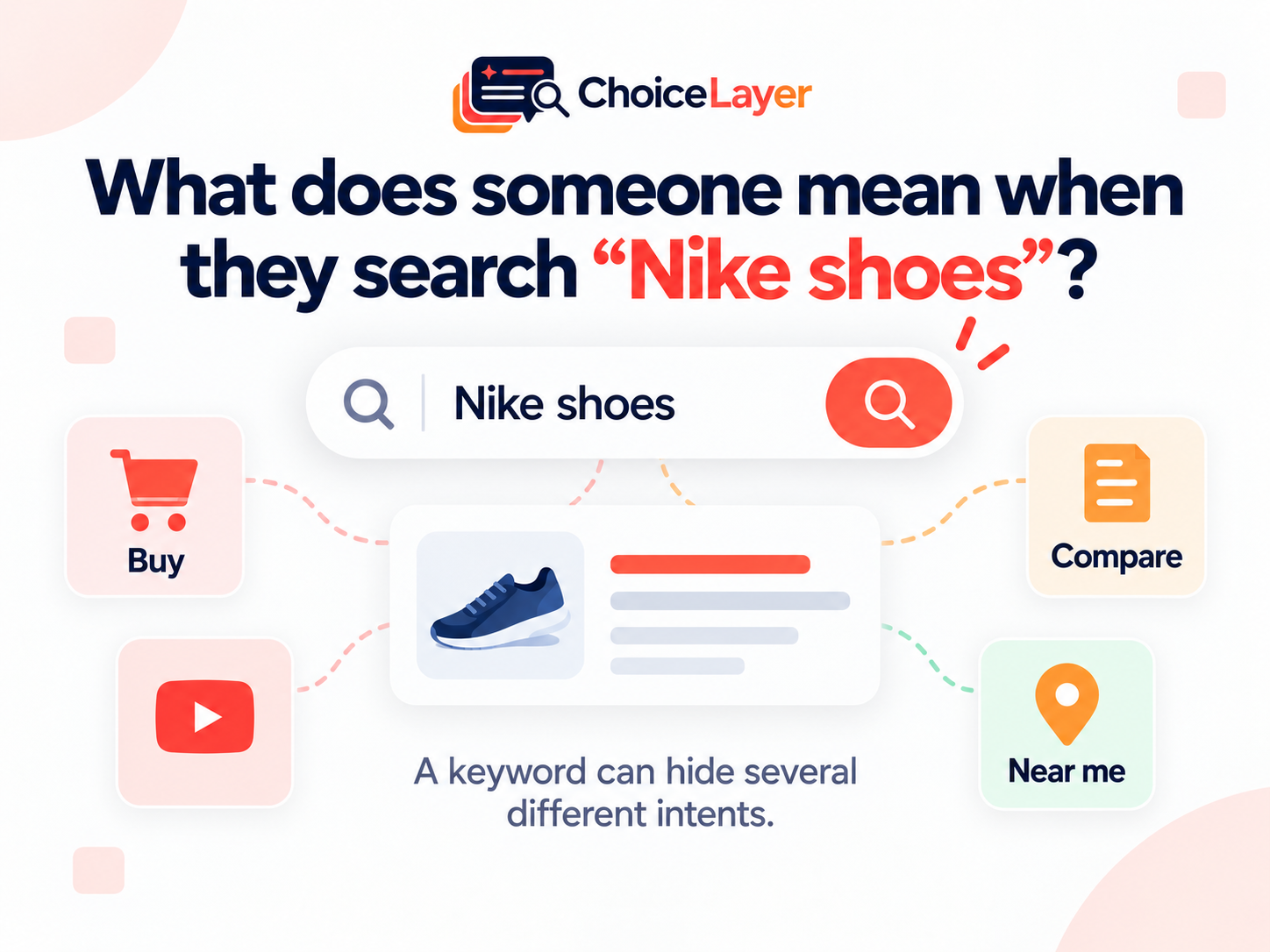
A search like “Nike shoes” looks simple.

Two words. Clear product category. Recognizable brand.
But from a search strategy perspective, it is actually quite ambiguous.
Someone searching for “Nike shoes” could want to:
- buy a pair of Nike shoes
- compare different Nike models
- find Nike running shoes
- look for the best Nike shoes for a specific activity
- find a Nike store nearby
- read reviews before purchasing
- compare prices across retailers
The keyword stays the same.
The intent behind the keyword changes.
That distinction matters because modern search optimization is no longer just about matching keywords. It is about understanding what the user is actually trying to accomplish and creating content that satisfies that need.
What Is Search Intent?
Search intent is the goal behind a query.
In other words:
What is the person actually trying to do?
A keyword tells you what someone typed.
Search intent helps you understand why they typed it.
That difference is important because the same keyword can represent several different needs.
For example, someone typing:
“Nike shoes”
might be thinking:
“I want to buy Nike shoes.”
Another person might mean:
“Which Nike shoes are best for running?”
Someone else might be asking:
“Where can I buy Nike shoes near me?”
Those users should not necessarily receive the same answer.
One Keyword Can Represent Multiple Types of Intent
Search intent is often grouped into several categories.

Transactional intent
The user is ready, or nearly ready, to take an action.
For example:
“Buy Nike shoes”
The best answer might be a product or category page where the user can browse sizes, models, pricing, and availability.
Commercial investigation
The user is researching before making a decision.
For example:
“Best Nike shoes”
or:
“Nike Pegasus vs Nike Vomero”
This person may benefit more from a comparison page, buying guide, review, or recommendation article.
Specific-need intent
Sometimes the user knows the category but has a particular use case.
For example:
“Nike running shoes for beginners”
The ideal content may explain which shoes are suitable for different types of runners instead of immediately pushing the user toward a product page.
Local intent
The user may simply want to know where something is available.
For example:
“Nike shoes near me”
In this case, store locations, opening hours, inventory availability, or directions could be more valuable than a long informational article.
Same Keyword. Different Intent.

This is why optimizing a page around a keyword alone can be misleading.
Imagine creating one page targeting “Nike shoes” and expecting it to satisfy every possible searcher.
A shopper looking to purchase wants products.
A runner wants recommendations.
A comparison shopper wants differences between models.
A local customer wants a store.
Technically, they may all be using closely related language.
But they are asking for very different experiences.
A better way to think about search optimization is:
Query → Intent → Right Answer

The query gives you the starting point.
Intent helps you interpret what the user needs.
The content should then deliver the most appropriate answer.
Why Search Intent Matters for SEO
Search intent has been important in SEO for years.
Ranking for a keyword is not especially useful if the page does not satisfy what the searcher actually wants.
For example, imagine someone searching for:
“best Nike running shoes”
If a brand sends that user directly to a generic product category containing hundreds of shoes, the page may technically be relevant.
But it may not be the most useful answer.
A guide comparing running shoes by cushioning, distance, experience level, and use case may match the search much better.

That is why effective SEO involves more than inserting keywords into titles, headings, and body copy.
Content format matters.
Page type matters.
Information depth matters.
The next action available to the user matters.
Search Intent Matters Even More for AEO
Answer Engine Optimization, or AEO, adds another layer.
Search engines increasingly provide direct answers rather than simply presenting a list of links.
A search engine may pull information from a page and display:
- a featured snippet
- a short answer
- a comparison
- a product recommendation
- a definition
- an AI-generated overview
That means your content needs to make the answer easy to understand and extract.
If someone asks:
“What are the best Nike shoes for running?”
the content should not bury the answer underneath hundreds of words of introductory text.
A strong answer might quickly explain:
- which models suit everyday running
- which are designed for speed
- which provide more cushioning
- who each model is best suited for
The clearer the structure, the easier it becomes for both users and answer engines to understand the content.
What Changes With GEO?
Generative Engine Optimization, or GEO, introduces an even broader context.
AI systems such as ChatGPT, Gemini, Perplexity, and other generative search experiences often do not respond to a query with one webpage.
They synthesize information from multiple sources.
The user may also ask much more detailed questions.
Instead of:
“Nike shoes”
they might ask:
“What Nike shoes should I buy if I run three times a week, mostly on pavement, and prefer extra cushioning?”
That query contains much more context.
The AI system is trying to interpret:
- activity
- frequency
- surface
- comfort preference
- purchase intent

This makes understanding intent even more important.
Content that clearly explains products, use cases, comparisons, limitations, and recommendations gives generative systems more useful information to work with.
Keywords Still Matter
None of this means keywords are becoming irrelevant.
Keywords are still useful for understanding:
- how people describe a topic
- what questions people ask
- how much interest exists around a subject
- how topics relate to one another
- what terminology customers use
The mistake is treating the keyword as the complete strategy.
A keyword is evidence of demand.
It is not always a complete explanation of intent.
The better question is not just:
“What keyword are we targeting?”
It is:
“What is the person behind this keyword actually trying to achieve?”
Build Content Around the User’s Real Goal
A useful content strategy begins by identifying likely intents around a topic.
Using the Nike example, one keyword cluster might lead to several different assets:
| Intent | Example query | Best content type |
|---|---|---|
| Purchase | Buy Nike shoes | Product/category page |
| Comparison | Best Nike shoes | Comparison or buying guide |
| Specific need | Nike running shoes | Use-case guide |
| Local | Nike shoes near me | Store locator |
| Research | Are Nike running shoes good? | Informational article |
| Comparison | Nike vs Adidas running shoes | Brand comparison |
This is more useful than trying to force every variation onto one page.
Each piece of content has a clearer job.
The Bigger Lesson for SEO, AEO, and GEO
SEO, AEO, and GEO are often discussed as though they require completely separate strategies.
In reality, they share a major foundation:
Understand the question and provide a useful answer.
SEO helps your content become discoverable.
AEO helps your information become understandable and extractable.
GEO helps your brand and expertise become usable within generative responses.
But all three depend heavily on understanding what the audience actually wants.
That is why search intent remains one of the most important concepts in modern search strategy.
Final Takeaway
The phrase “Nike shoes” is a good reminder that a keyword can look simple while hiding several different intentions.
Someone may want to buy.
Someone may want to compare.
Someone may want running advice.
Someone may just want the nearest store.
The words stay the same.
The user’s goal changes.
So instead of optimizing only for what people type, optimize for what they actually need.

Keywords tell you what people type.
Intent tells you what they need.
Leave a Reply